
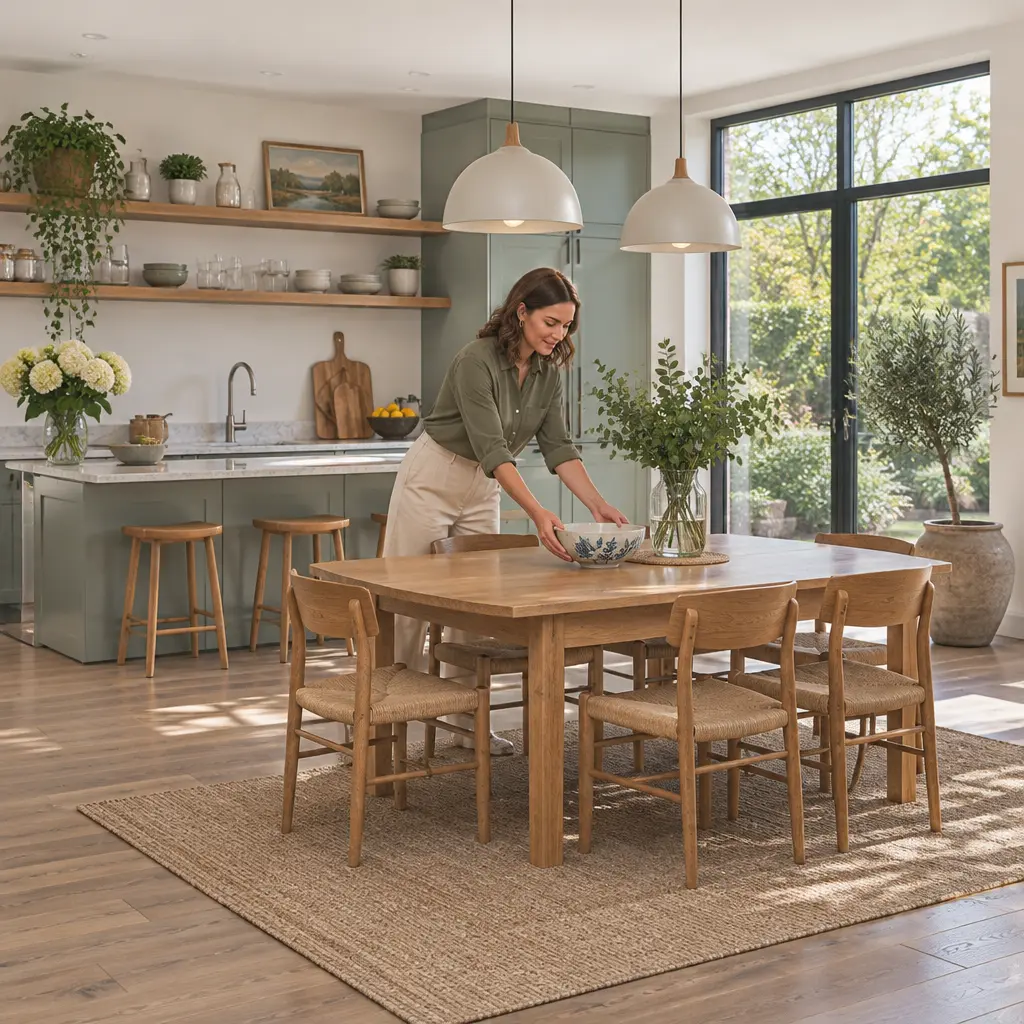
Modern kitchen and dining accents are the nonstructural objects and finishes that shape a kitchen or dining area’s appearance, atmosphere, and everyday experience. Beyond functional storage, carefully chosen lighting, textiles, tableware, greenery, wall art, and decorative objects can make a space feel more personal and welcoming without sacrificing usefulness. Their value is especially relevant as kitchens serve multiple roles: the American Institute of Architects’ home-design research has repeatedly identified open layouts and kitchen-centered living as persistent residential preferences, while the U.S. Environmental Protection Agency estimates that indoor air can be more polluted than outdoor air—an important reminder to favor easy-care, low-emission materials and avoid clutter that collects dust.
Modern Kitchen and Dining Accents as Atmosphere-Building Elements
An accent is a design element selected to add contrast, texture, color, visual focus, or character to a room. In kitchen and dining spaces, accents include both movable items—such as vases and serving bowls—and fixed or semi-fixed details, including pendant lights, cabinet hardware, and feature-wall finishes. The American Society of Interior Designers describes interior design as shaping interior environments to support health, safety, and well-being; this broader perspective helps explain why accents are more than decoration: they influence how a room is perceived and used.
A useful distinction is between an accent’s primary purpose and its secondary effect. A pendant light provides illumination, but its form and placement also establish a focal point. A ceramic bowl can serve food while contributing color and texture. This overlap between utility and expression is particularly valuable in compact homes, where every visible object competes for space and attention.
Lighting as a visual and practical accent
Accent lighting is illumination used to draw attention to a feature or create visual depth, rather than to provide all the light a room needs. Pendant fixtures above an island or dining table, wall sconces, and concealed cabinet lighting can create distinct zones within an open-plan space. The U.S. Department of Energy recommends using light-emitting diode (LED) bulbs because they use at least 75% less energy and last up to 25 times longer than incandescent lighting. Choosing efficient LEDs therefore supports both atmosphere and reduced energy use.
Textiles, color, and tactile contrast
Textile accents include washable table linens, seat cushions, runners, and curtains. They soften hard surfaces and can introduce color without a permanent renovation. Color and texture work especially well when they relate to existing finishes—for example, linen against polished stone or a muted runner against dark wood. In food-preparation zones, choose materials that are easy to launder or wipe down, and keep loose fabric away from cooktops and other heat sources.
Tableware and serving objects as display
Decorative tableware includes plates, pitchers, serving boards, bowls, and glassware selected for their visual qualities as well as their intended use. Grouping a few related objects on open shelving or a sideboard can make everyday items feel curated. The effect is strongest when collections have a shared feature—such as material, shape, or color—rather than simply accumulating many unrelated pieces.
These atmosphere-building choices establish a room’s character. The next step is to consider accents that connect that character to nature, craft, and personal identity.
Modern Kitchen and Dining Accents as Expressions of Nature and Craft
Natural and handcrafted accents bring visible material variation into rooms dominated by manufactured surfaces. Wood grain, woven fibers, ceramics, stone, and living plants can add warmth and make a kitchen or dining space feel less uniform. These materials are not automatically sustainable or maintenance-free; their suitability depends on sourcing, durability, cleaning requirements, and placement.
Plants and botanical arrangements
Botanical accents range from a vase of cut branches to herbs grown in a sunny window. They introduce organic shapes and seasonal change, while culinary herbs can also be harvested for cooking. The U.S. Department of Agriculture’s National Agricultural Statistics Service reported that the United States had 17,488 greenhouse, nursery, and floriculture operations in the 2022 Census of Agriculture, illustrating the scale of domestic plant production. For kitchens, select plants suited to available light and keep soil, leaves, and standing water away from food-contact surfaces.
Handmade ceramics, wood, and woven materials
Handmade or visibly textured objects can serve as small focal points because their irregularities distinguish them from smooth cabinetry and appliances. A turned wooden bowl, woven placemats, or a handmade ceramic vase can provide that contrast. For items used with food, verify that glazes and finishes are intended for food contact, and follow the maker’s care instructions. Wood should be kept in good condition and dried thoroughly after washing; porous or delicate pieces may be better suited to display than frequent food service.
Art and meaningful personal objects
Wall art, framed prints, heirlooms, and travel objects make a dining space more individual. The most effective arrangements relate to the room’s scale: a single larger artwork can anchor a wall, while a small grouping can add interest to a breakfast nook. In kitchens, protect art from direct heat, steam, and grease, and use secure mounting where objects hang above seating or circulation areas.
Nature and craftsmanship bring individuality, but they also need to work with the room’s physical conditions. Material selection and placement therefore connect personal style to durability, safety, and maintenance.
Modern Kitchen and Dining Accents as Durable, Low-Clutter Choices
A durable accent retains its appearance and function under the conditions of its location. In kitchens, those conditions include cooking heat, moisture, splashes, frequent cleaning, and everyday handling. In dining areas, furniture movement and spills are common considerations. Treating durability as part of the design decision helps avoid decorative choices that quickly become inconvenient or need replacement.
Choosing materials for real kitchen conditions
Material suitability depends on exposure. Metal, glass, and many glazed surfaces are straightforward to wipe clean, while untreated wood and some fabrics require more care. The Environmental Protection Agency advises consumers to consider indoor sources of volatile organic compounds (VOCs), which can be emitted by certain building materials, furnishings, paints, and household products. When adding finishes or newly manufactured objects, check product information, ventilation guidance, and relevant emissions certifications rather than assuming that a natural-looking material is automatically low-emission.
Scale, negative space, and visual balance
Negative space is the open area around furnishings and objects; it gives the eye room to distinguish important features. In practice, this means leaving preparation counters usable, keeping dining-table arrangements low enough for conversation, and avoiding crowded shelves. A small number of well-chosen accents often creates a clearer focal point than many competing objects. Before purchasing, measure the intended surface and consider how the item affects movement, cleaning, and access to frequently used equipment.
Lighting, glare, and energy performance
A layered lighting plan combines general illumination with task and accent light. A decorative fixture should not create glare for seated diners or shadows on work surfaces. LED technology offers a practical way to combine decorative appearance with efficiency: the Department of Energy’s comparison—at least 75% less energy use and up to 25 times the lifespan of incandescent bulbs—supports choosing LEDs for frequently used fixtures. Dimmers and appropriately placed switches can further help tailor light to cooking, dining, or entertaining.
A practical example: refreshing a dining nook
A renter updating a compact dining nook could begin with a warm-toned LED pendant, washable placemats, and one framed print secured to the wall. A small herb pot near a suitable window adds a living element, while a ceramic serving bowl provides a useful centerpiece. The arrangement remains adaptable because its main accents are movable, uses little counter space, and avoids relying on a large collection of objects. This illustrates a general principle: combine one or two strong visual cues with items that are easy to clean, reposition, or use.
Conclusion: Design Accents That Make Kitchens More Personal
Modern kitchen and dining accents extend well beyond storage. Lighting, textiles, tableware, plants, crafted materials, and artwork can build atmosphere, express personal taste, and make everyday routines feel more considered. The strongest choices balance visual character with the room’s practical demands: energy-efficient lighting, materials suited to their exposure, secure placement, and enough open space for cooking and conversation. Start by identifying one area that feels impersonal or unfinished, then choose a small number of durable accents that improve both its appearance and use. For further guidance, consult energy-efficiency information from the Department of Energy and indoor-air-quality resources from the Environmental Protection Agency.
Sources: American Institute of Architects, Home Design Trends Survey, https://www.aia.org/resource-center/home-design-trends-survey; American Society of Interior Designers, What Is Interior Design?, https://www.asid.org/about/what-is-interior-design; U.S. Department of Energy, LED Lighting, https://www.energy.gov/energysaver/led-lighting; U.S. Environmental Protection Agency, Volatile Organic Compounds’ Impact on Indoor Air Quality, https://www.epa.gov/indoor-air-quality-iaq/volatile-organic-compounds-impact-indoor-air-quality; U.S. Department of Agriculture, National Agricultural Statistics Service, 2022 Census of Agriculture, https://www.nass.usda.gov/Publications/AgCensus/2022/
